
Housing
Blue-tongued skinks are not good climbers, so horizontal space matters far more than height. Plan for a minimum 55-gallon enclosure, and remember that larger is always better. Skinks should be housed alone, since they may fight if kept together, and the enclosure needs a sturdy mesh or ventilated top.
Skinks don't need elaborate décor, but they do need security and enrichment. Provide at least two hiding places, one on each end of the enclosure — rounded cork bark slabs and cylindrical hides such as PVC pipes are usually well accepted. A humid hide filled with damp sphagnum moss should always be available to help with shedding. Although skinks are ground-dwelling, many enjoy exploring low branches and logs, so varied textures and levels encourage natural movement and improve overall well-being; just avoid overcrowding the enclosure.
For substrate, stick to paper products or reptile carpeting — both are safe, inexpensive, and easy to clean. Avoid corncob, wood shavings, reptile bark, and sand or gravel, which can be ingested and cause intestinal impaction, harbor bacteria and fungi, and irritate the respiratory system.
Cleanliness matters as much as setup. Remove uneaten food daily, and clean and disinfect the enclosure at least weekly using mild soap followed by a disinfectant solution (one capful of bleach per gallon of water, or a commercial reptile disinfectant used per label directions). Rinse thoroughly and dry completely before returning your skink to its enclosure.
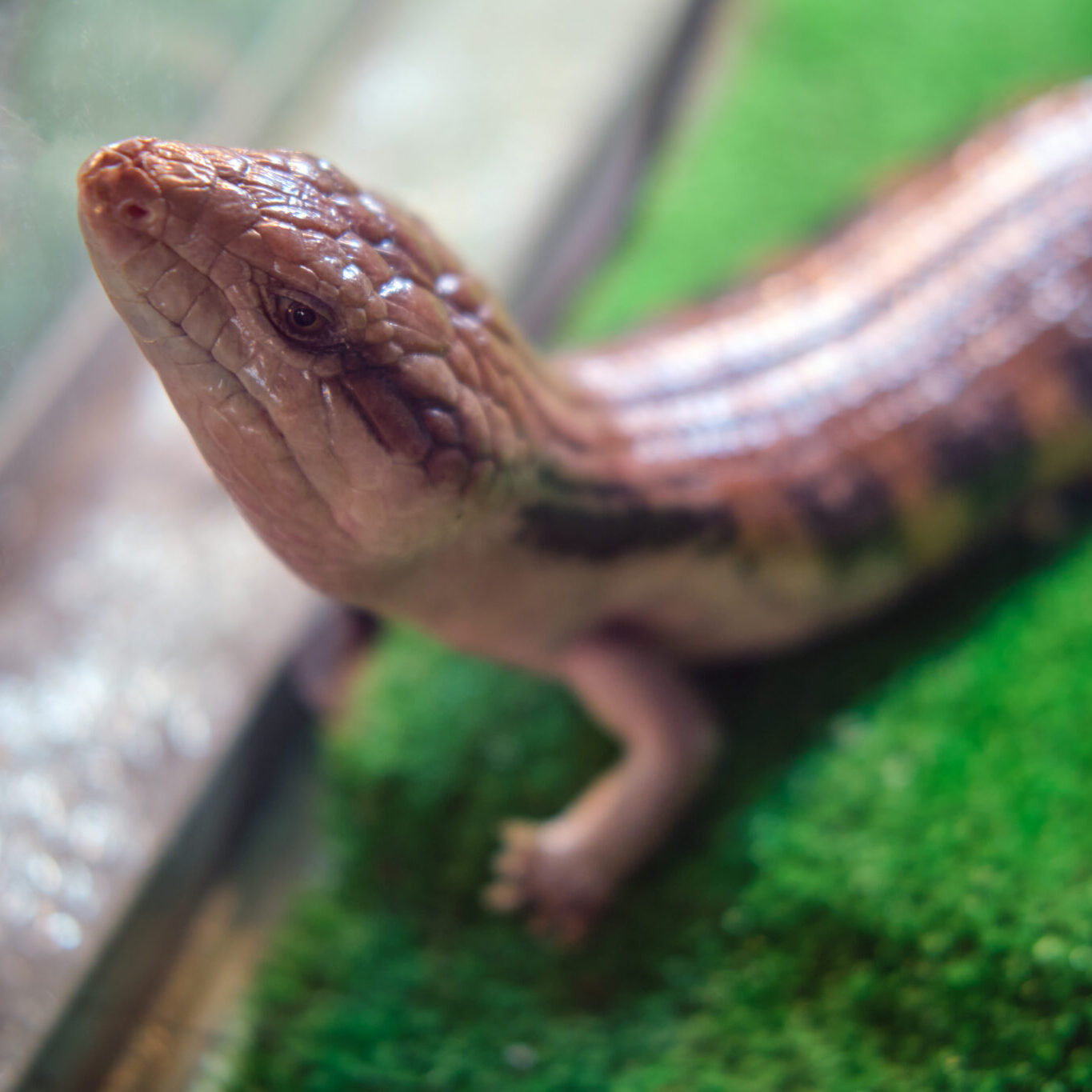
Handling
Give a new skink several days to acclimate before handling, and begin only once it's eating regularly. Keep early sessions to 10 minutes or less, and handle over a soft surface or close to the floor. Always support the body fully, and never grab a skink by the tail — tail injury is easy to cause and regeneration is poor. Because skinks can't regulate their body temperature outside the enclosure, it's important to keep handling sessions limited in duration.
Temperature and Lighting
Blue-tongued skinks require UVA/UVB lighting for 10–12 hours a day, year-round. Without adequate UVB exposure, they can develop loss of bone density, weakness and fractures, and metabolic bone disease. UVB bulbs stop producing effective UV long before their visible light burns out, so replace them every six months and date them when installed — and keep in mind that UVB bulbs don't produce heat, so they need to be paired with a separate heat source.
General temperature guidelines are a cool side around 75°F, a warm side around 88°F, a basking area of 90–95°F, and nighttime temperatures that can drop to 70–75°F, though preferences vary slightly by species. A heat lamp placed over one end of the enclosure creates this gradient; choose the bulb wattage carefully to hit the right temperatures. Under-tank heaters can gently raise ambient temperature but must be on a thermostat or rheostat, since skinks burrow and are at increased risk of thermal burns if a heat pad is used without a protective barrier. Place thermometers at ground level on both sides of the enclosure to monitor temperatures accurately.
You can learn more about UVB Light here.
Diet & Hydration
Blue-tongued skinks are omnivores and need a balanced mix of protein and plant material, fed every other day. Vegetables and greens should make up roughly 45–60% of an adult's diet. Offer fresh, pesticide-free produce suitable for human consumption, with calcium-rich greens like mustard greens, kale, dandelion greens, and collard greens forming the bulk, supplemented with peas, green beans, corn, squash, carrots, sweet potato, cucumber, zucchini, bell peppers, and parsley. Juveniles prefer finely chopped food, while adults do better with coarser pieces.
Protein should make up about 50% of a juvenile's diet, tapering down as they mature into adulthood, and can come from gut-loaded crickets, mealworms, king worms, snails, and pinky mice. Waxworms are high in fat and should only be occasional treats; keep insects no larger than the distance between the skink's eyes, and remove any uneaten insects after 10 minutes. Dust insects with a calcium supplement — without phosphorus or vitamin D — twice weekly, and gut-load them before feeding.
Fruit should make up no more than 5–10% of the diet. Melons, apples, pears, peaches, berries, grapes, and plums are all fine in moderation, and edible flowers like hibiscus, dandelion, and nasturtium can be offered occasionally. Avoid avocado, eggplant, rhubarb, and high-sodium foods.
Fresh water should be available at all times in a shallow, sturdy bowl that can't tip, large enough for full-body soaking, which helps with shedding. Change the water daily, and disinfect the dish at least weekly, since skinks often defecate in it.
Common Health Problems
A few conditions are worth watching for. Nutritional secondary hyperparathyroidism (NSHP) shows up in juveniles with inadequate calcium or UVB, with early signs including tail kinks and spinal deformities. Parasites such as amoebas and flagellates are common, which is why twice-yearly fecal testing is recommended. Respiratory disease — marked by sneezing, nasal discharge, or open-mouth breathing — needs prompt veterinary care and is often linked to poor humidity control, so aim for around 50% humidity. Stomatitis, an infection of the mouth and gums, is often related to diet or poor hygiene and requires veterinary treatment. Dysecdysis, or retained shed, is common on the toes and tail tip; it's prevented with proper humidity and vitamin-A-rich vegetables, and repeated retained sheds can cause loss of circulation and tissue damage.
On the preventative side, juveniles should have exams twice a year and adults annually, with yearly bloodwork to assess calcium and phosphorus levels and fecal testing for parasites. Signs of illness in skinks can be subtle, so early detection makes a real difference in outcomes.
Is a Blue-Tongued Skink Right for You
Blue-tongued skinks are intelligent, personable lizards with long lifespans. A proper diet, correct lighting, and routine veterinary care are essential to keeping them healthy for decades. Book an appointment online today.
Or give us a call at (603) 882-0494!